

Correspondence 8: Stone Chairs
Time design?

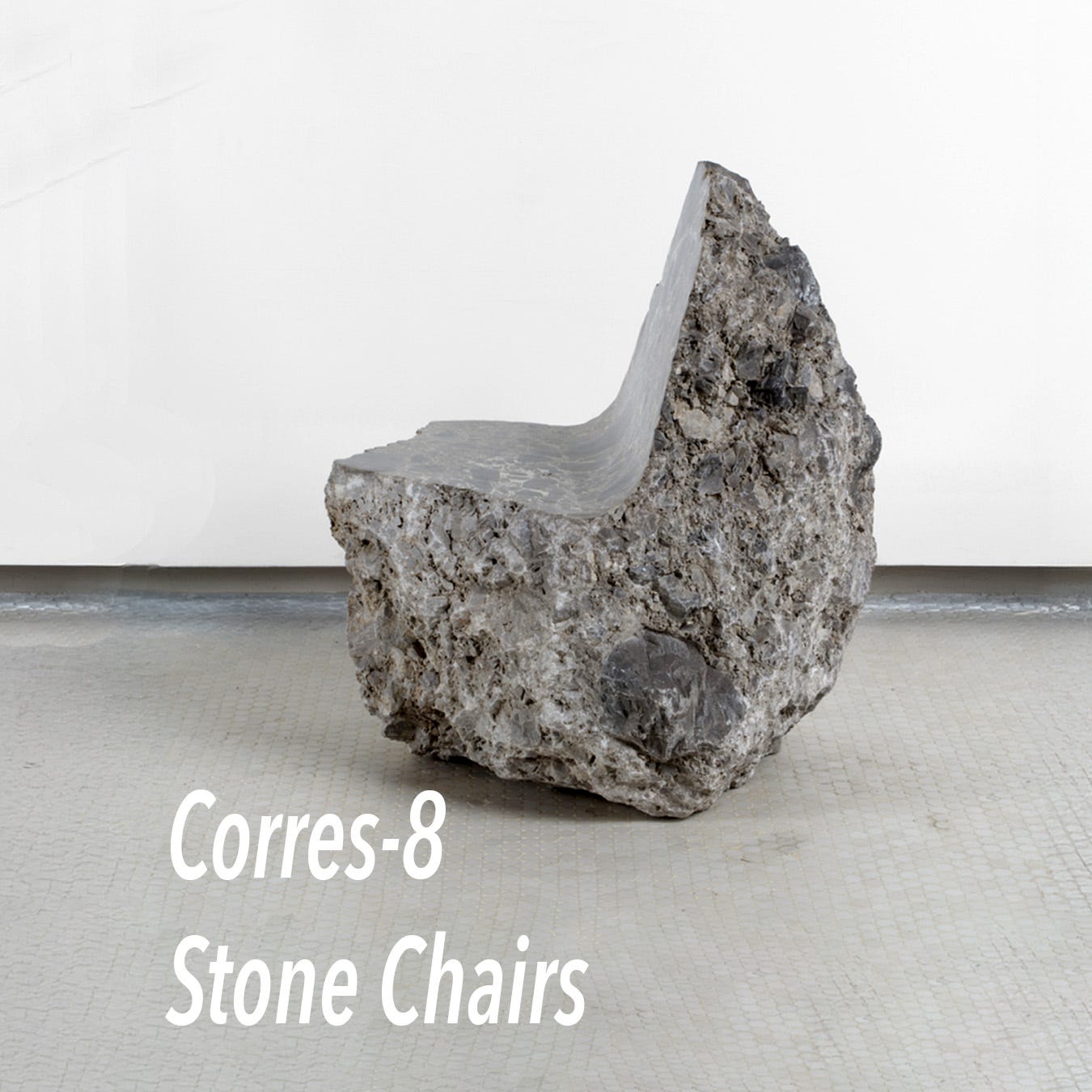
Want to make your chair sustainable? Stand up to critique? Weather the test of time that separates the object from the artifact? What better way to do so than to make it from one of the most durable, non-synthetic materials known to man: stone.
Of course, we are hoping that you, with your new igneous swag, don’t have to move house anytime soon.
Jokes aside, we are interested in the persistence of the stone chair, which, at its most ideal, consists of a seat carved directly from a hunk of stone.
Stone furniture is one of those design objects that relies on its context to such an extent that it becomes almost anxiety-inducing. When one sees a headline about rotating stone chairs by a celebrity designer such as Sabine Marcelis, one is glad to find out that it’s outside, that it’s temporary, and that it was largely a marketing ploy for a stone company.
One finds comfort in the usually anonymous, unpretentious stone furniture that dots parks and trails, is charmed by the building ledge shaped correctly for a tush, a dispensation of the monumental toward the (sometimes) minuscule.
But a stone chair inside? That’s something else entirely.
The solid stone chair speaks to the overlap between architecture, sculpture, and design. Working with stone is almost a rite of passage for a designer, connected through it as one is to the Italian stone masons, the pyramids—hell, even the cavemen, who invented art, after all.
Stone is both impractical and thus luxurious; ubiquitous as rock and thus grounding, chthonic. It takes immense effort and resources to work with stone and move it. Yet, it always seems somewhat primordial, backwards, overly referential. Many designers working with it today reference some antiquity, whether it be Egyptian or Mesoamerican, and we are, honestly, confused by anyone who thinks that reclaiming monumental stone from emperors past is the syncretism we should be practicing.
But in some circumstances—museums, certain hotels—it makes sense, and, if well carved, can even be surprisingly comfortable. It evokes durability for guests, and investment when other luxury furniture has to be further signified with brand names or setting. Nothing says we’re here to stay like marble.
Some of the designers leave stones rough or just smooth in parts, to in part the appearance of being directly shaped by nature. Maybe when the rivers are gone, we will cling to this last representation.
These stone chairs show the concept of the chair as it might exist in nature, who hasn’t found a nicely shaped rock in Central Park or elsewhere on which to sit? This eternal appeal links us back to other times, projecting our current production and input into the future.
At worst, it demonstrates the excess of furniture. It shows us that, if we want to get back to nature, we may as well sit on the ground, as many still happily do.
Is the replication of the processes of time always a gimmick? A shadow of patience in our hyperreality? And what does it take to let the material show its character, to appropriately guide it into place? Isn’t intervention in material the point?
Here are a few interesting pieces that can guide us to an answer.
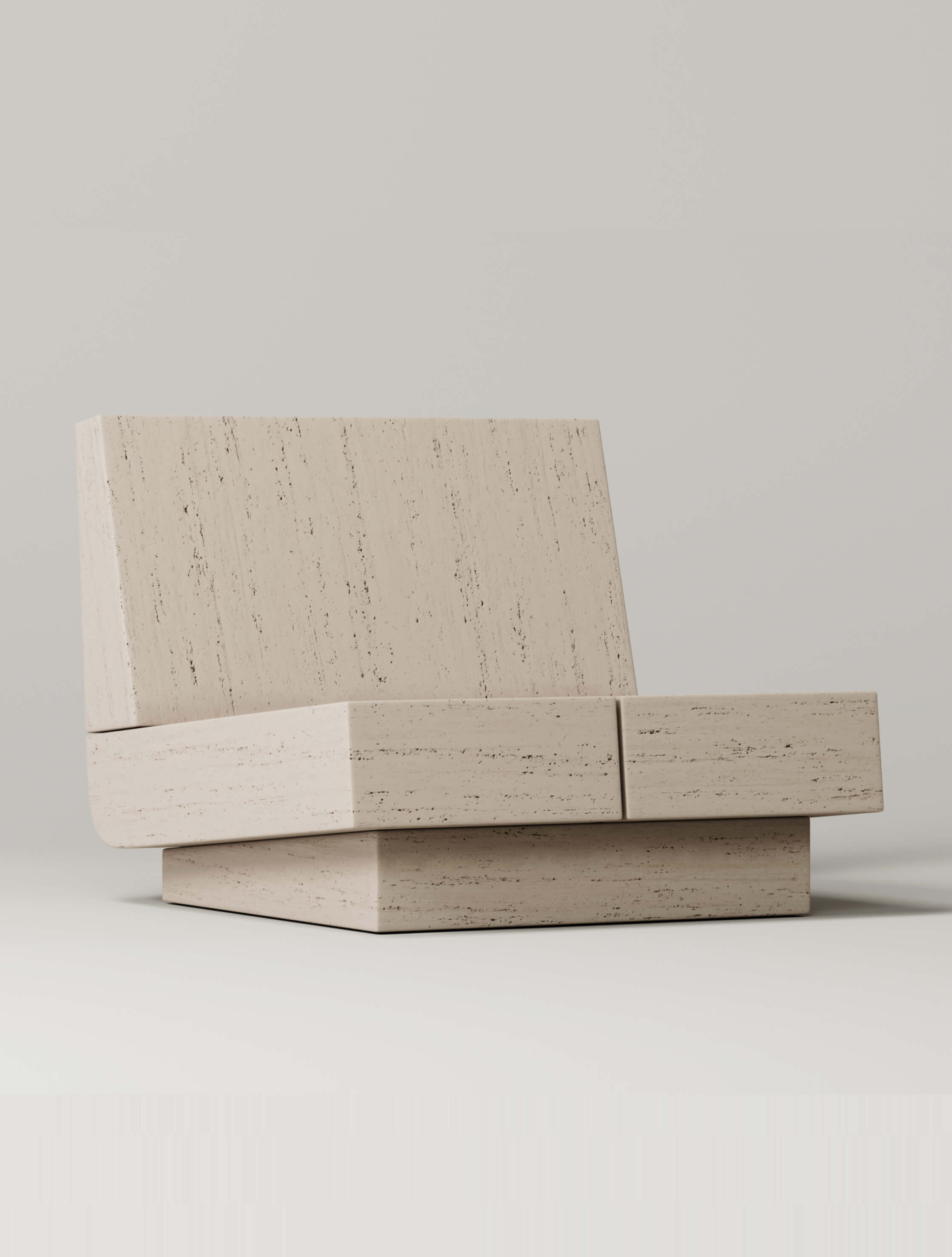
Four interlocking slabs of travertine stone are angled together to form New York practice Monolith’s Lounge Chair. The studio said the chair “beckons you to sit.” It also beckons you to call in the legions, drape it in animal furs, and sit, rigid, chin resting on fist. The pared-back design weighs only 200 lbs, which, given its bulk, is the most interesting design innovation here. Remarkably, one of the marketing images has the chair placed in what appears to be a cave.
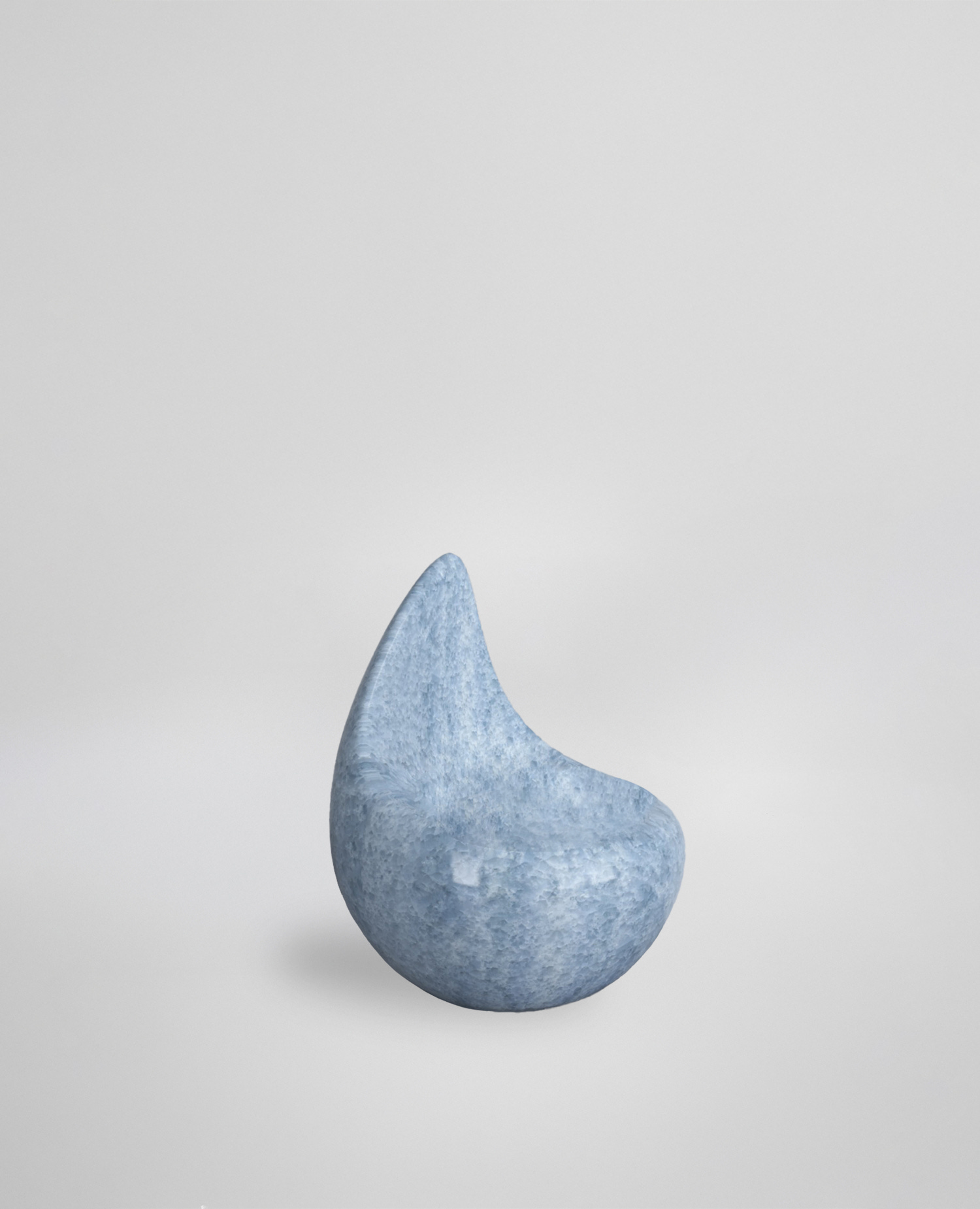
Mexico City-based Sten Studio leans on the local bounty of stone, putting out collections of sculptural, functional and non-functional pieces. Its Hydrea chair is carved from a single piece of blue calcite. The marketing images are telling here too, with the design displayed with other floral-shaped stones for the overarching collection at what appears to be architect Javier Senosiain’s El Nido de Quetzalcóatl, a fantastical place. The shape here somehow evokes lightness, and if there is a market for Senosiain’s fantastical work, maybe there’s one for this piece as well.
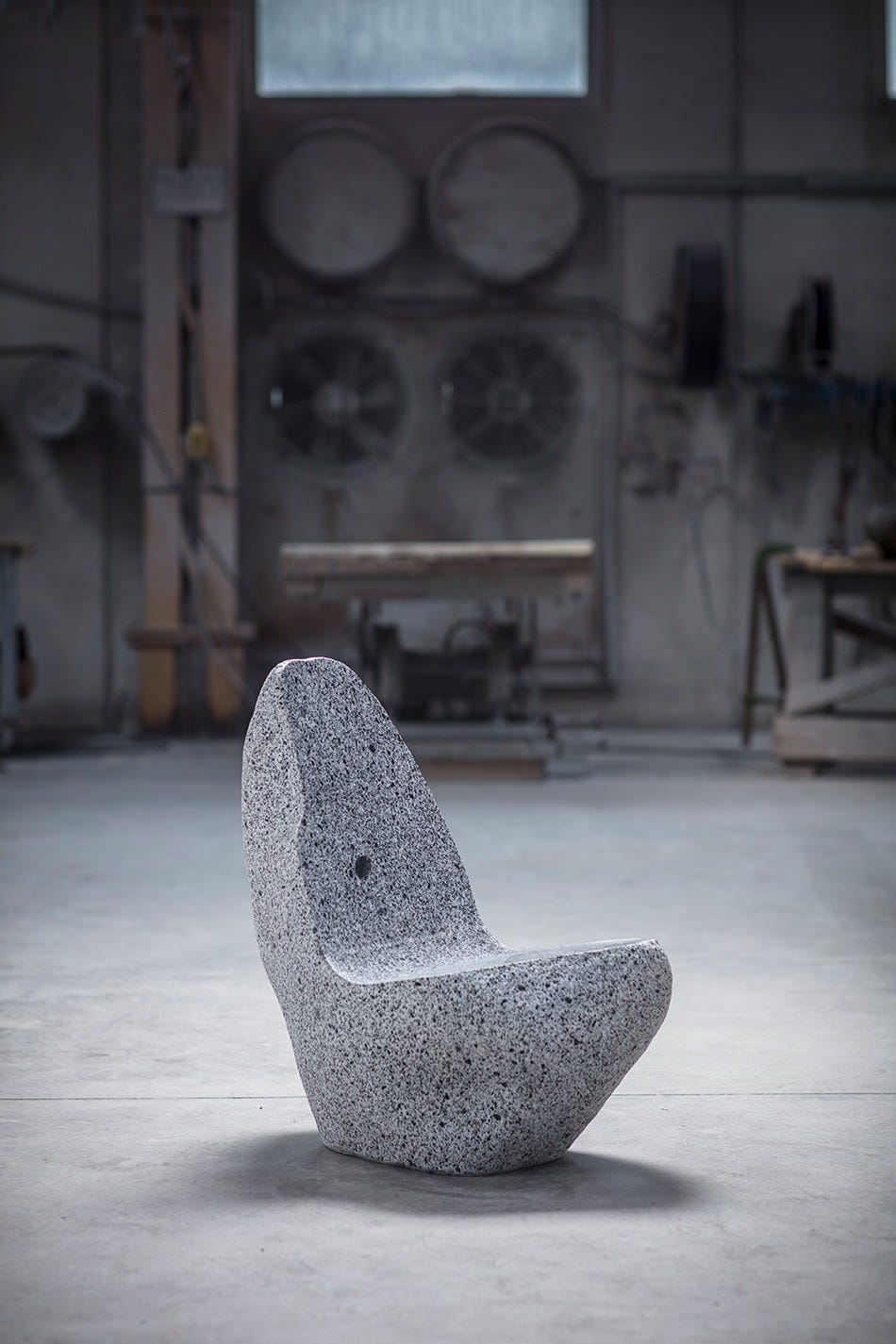
Material polymath Max Lamb created the Boulders series in 2017 from Tonalite granite, left raw in some places and polished in others. Apparently, the collection was inspired by his fascination with the power of rivers to shape rocks over time. Lamb is great at showing how the material guides the formation of work, and the pieces would resonate better if they were made, say,, for a park or an actual riverside. The “honoring” of natural processes by entirely circumventing the fact of the immense time it takes water to carry them out, not just the dexterous articulation of a CNC-router immediately carving the form according to a predetermined contour, rings hollow here.
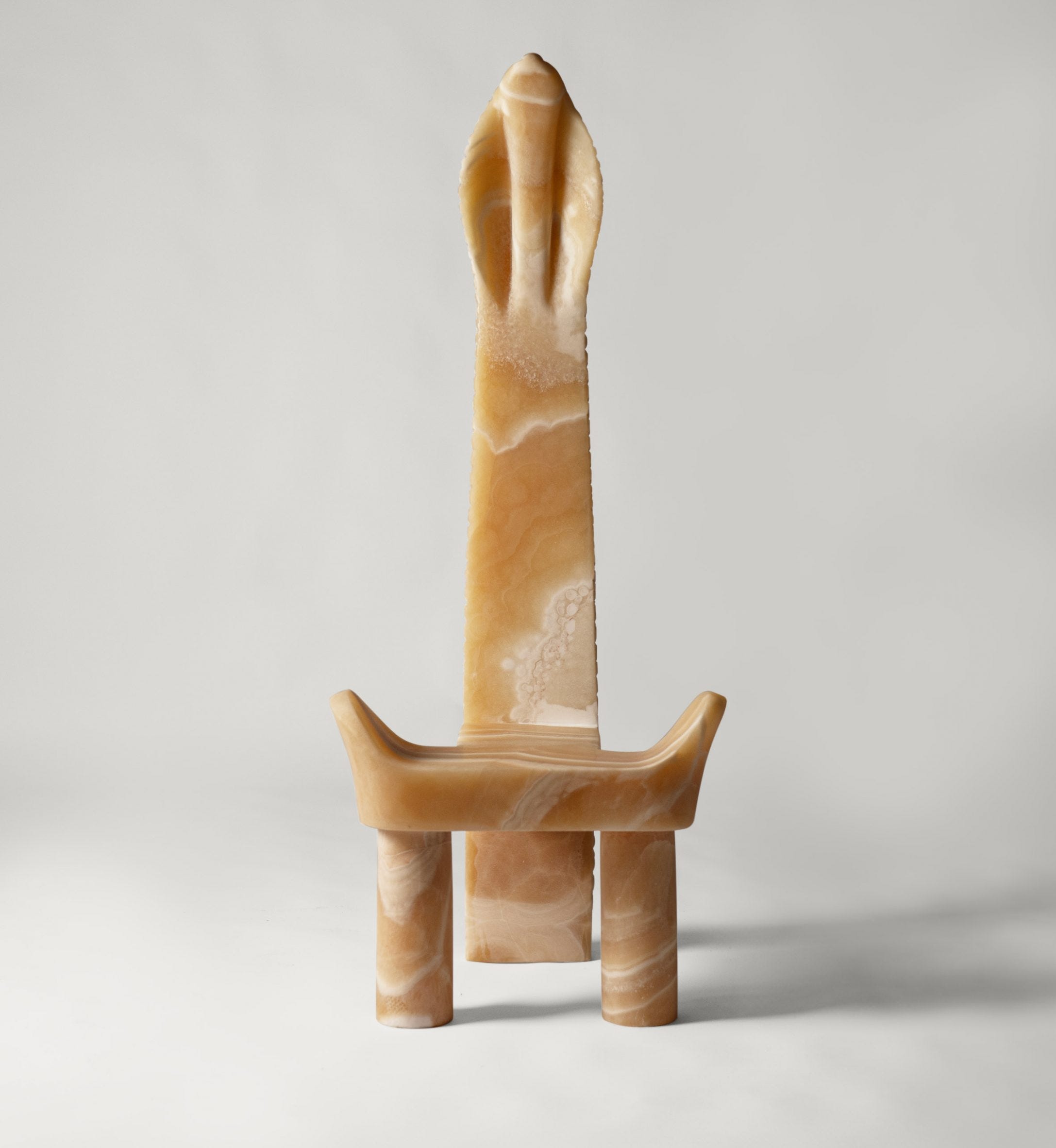
Formally, this chair from Omar Chakil’s Transcendence series is the most interesting of the bunch. One could see the design popping back up in the future, unearthed in some billionaire bunker or private collection, anachronistically sitting next to actual historical artifacts, confusing whatever archaeologist the future produces. Its high back and sensitive carving project the syncretic cultural design that Chakil is going for, and as an object, we feel it has some immense, almost occult appeal. Isn’t projection a function, too?
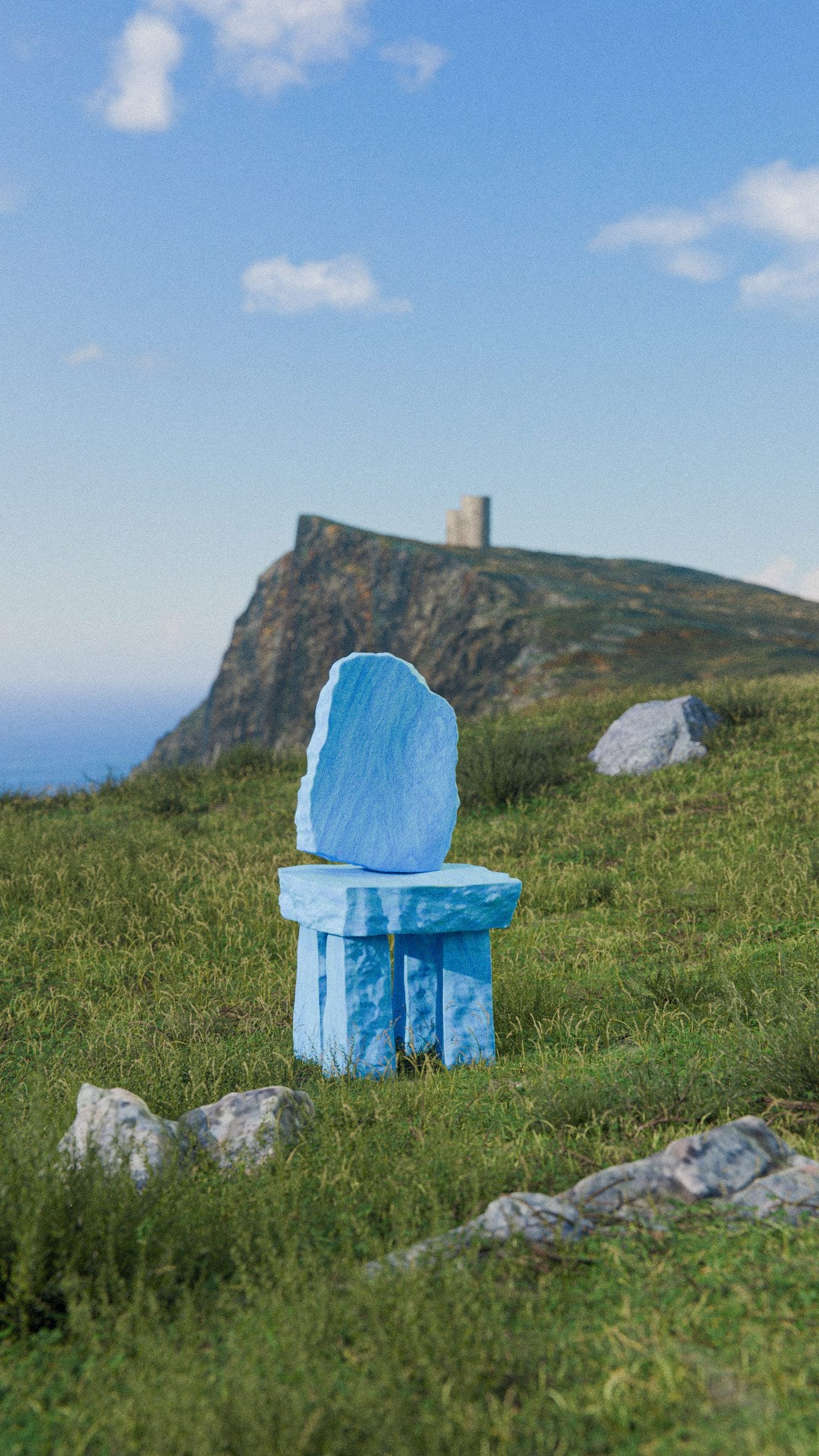
It’s hard not to smile when looking at Studio Bucky’s Portals Collection, which takes formal cues from portal stones. And though it’s not stone (it’s painted wood), the fact of using contemporary materials to shape things to look ancient is an interesting irony. Here too, as in Chakli, the mythic weight of the past is summoned for contemporary appeal. Hopefully, the ritualistic shapes can conjure some of their ancient weight to capture the attention of wandering interior designers and editors on the trade show floor.
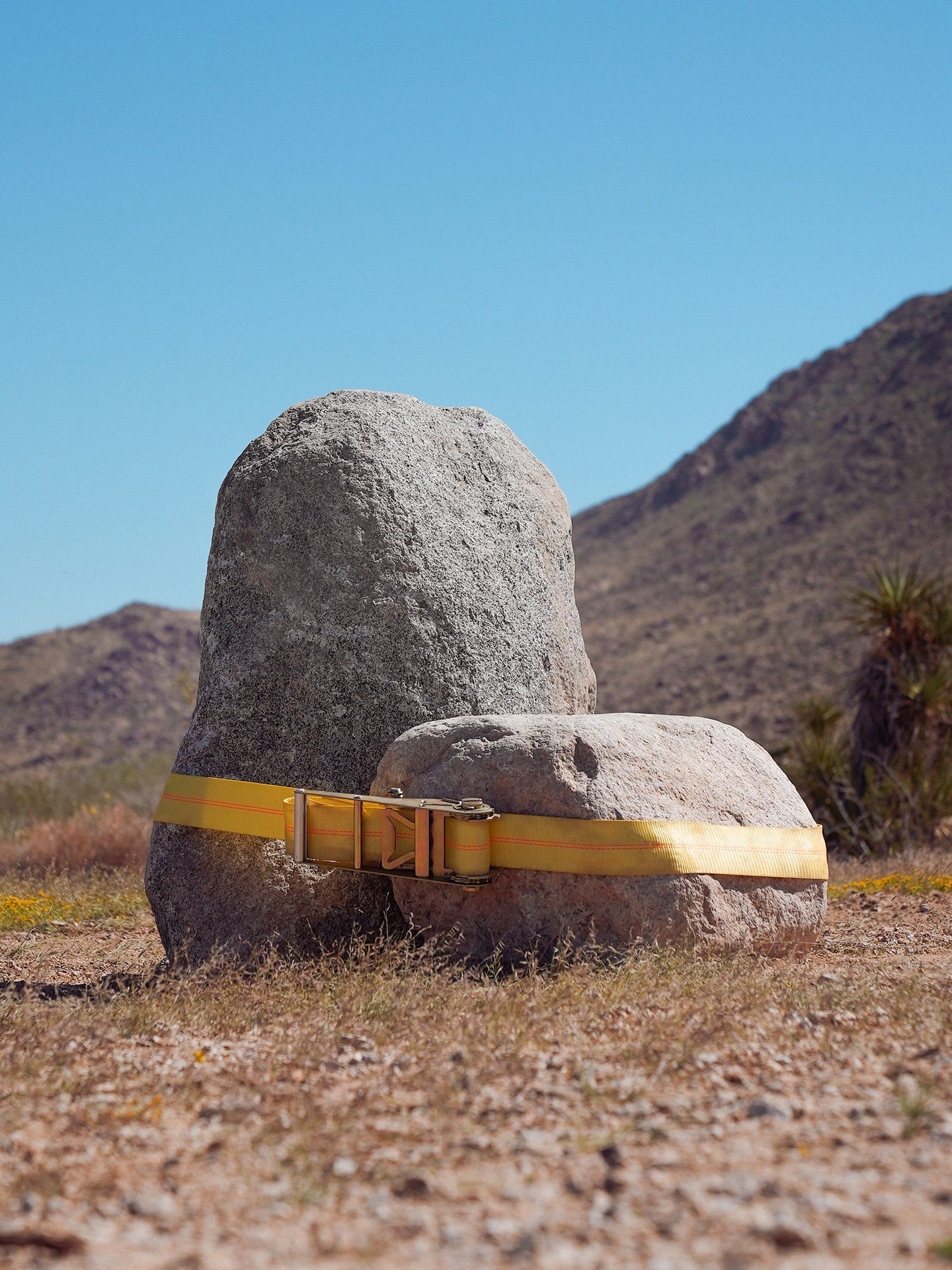
Nicholas Baker really hit the mark here, using a ratchet strap to fasten together two boulders into a makeshift chair in the desert in California. Here, the sheer functional unnecessaryness and manual work of the procedure has appeal, and Baker’s desire to shape environments through inventive means, for no apparent commercial purpose, is most similar to the natural processes that the others are trying to invoke. One can’t see this anywhere else but outside, natural ergonomics at home, and for that we salute it.
Such a great round up! My fave is Mario García Torres’ ‘Acapulco Chair' just so gorgeous